Professional Sanicubic 2 Classic Engineer in Ireland
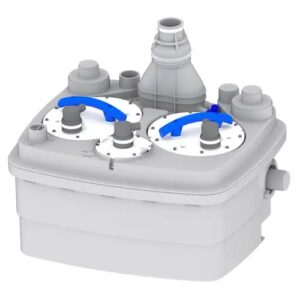
The Sanicubic 2 Classic is a heavy-duty duplex lifting station for black water and grey water. It is designed for larger domestic properties, busy commercial premises and other buildings where conventional gravity drainage is not available.
Two separate macerating pumps operate alternately during normal use. Therefore, operating hours are shared between the motors rather than concentrated on one pump.
If incoming flow increases, both pumps can run together. In addition, the second pump can take over if the duty pump develops a fault. This duplex arrangement provides valuable operational protection where several toilets and sanitary appliances depend on one lifting station.
The system can receive wastewater from suitable WCs, wash basins, sinks, showers, baths, bidets, washing machines and dishwashers. However, correct system selection still depends on expected flow, discharge conditions and the complete drainage design.
At Saniflo.Irish, we have serviced, repaired and replaced Sanicubic lifting stations since 2015.
As an Approved Saniflo Engineer authorised by SFA Saniflo, we specialise exclusively in Saniflo products.
Our experience helps us diagnose pump, control, level-activation and installation faults accurately. Where appropriate, we use genuine Saniflo replacement parts.
We also inspect the surrounding discharge pipework, ventilation, electrical supply, isolation arrangements and future service access before recommending a long-term solution.
Whether your lifting station needs preventative servicing, professional repairs or complete replacement, we can help.
Our aim is always to restore dependable operation while keeping disruption to your home, business or managed property to a minimum.
Common Sanicubic 2 Classic Problems
A duplex lifting station often serves several fixtures and may operate many times throughout the day. Consequently, preventative maintenance plays an important role in long-term reliability.
From our experience, many faults develop gradually because unsuitable materials, internal deposits or installation restrictions increase the workload on the pumps.
Wet wipes, sanitary products, cleaning cloths and other non-biodegradable materials can obstruct the macerating systems. Grease, detergent residue, organic deposits and limescale may also collect inside the tank or connected pipework.
As resistance increases, pumping cycles may become longer. The motors can then experience additional strain, while the building may show slow drainage or recurring high-level warnings.
Electrical and control faults can also affect operation. For example, a problem with one motor, the pneumatic level system, the control box or a non-return valve may prevent correct alternating operation.
Installation quality remains equally important. Poorly designed discharge pipework, unnecessary bends, inadequate ventilation, unsuitable isolation arrangements and restricted service access can all create avoidable problems.
Common Symptoms We Repair
Some of the most common symptoms include:
- One pump does not operate
- Both pumps run continuously
- Lifting station does not start
- High-level alarm activates
- Control box shows a fault
- Slow pumping performance
- Water backs up into toilets or other fixtures
- Blocked macerating system
- Blocked or restricted discharge pipe
- Non-return valve failure
- Pneumatic level-activation fault
- Motor or capacitor failure
- Electrical fault or tripping supply
- Internal leakage
- Unusual noise or vibration
- Bad odours
- Frequent or irregular cycling
First, we identify the actual cause. Then, we explain the most practical repair and any installation improvements that may help prevent the problem from returning.
Common Faults We Repair
Customers often contact us after searching for one of the following Sanicubic 2 Classic problems:
- Sanicubic 2 Classic not pumping
- Sanicubic 2 Classic alarm sounding
- One Sanicubic pump not working
- Both pumps running continuously
- Duplex lifting station fault
- Sewage lifting station blocked
- Water backing up into toilets
- High-level alarm activated
- Sanicubic 2 Classic leaking
- Control box fault
- Level sensor or pneumatic activation fault
- Macerator motor failure
- Commercial sewage pump repair
- Sanicubic 2 Classic service
These descriptions may point towards the fault, but a complete diagnosis is still necessary because several different problems can produce similar symptoms.
From Our Experience
The duplex design is a major advantage when a building depends on reliable wastewater removal. During normal operation, the two pumps alternate and share the workload.
If one pump needs attention, the other may continue operating. However, this protection should not be treated as a reason to postpone repairs. The remaining pump may have to carry the full load and could experience additional wear.
We have also found that many apparent lifting-station faults originate outside the tank. Restricted discharge pipework, failed isolation valves, incorrect ventilation or unsuitable alterations can all reduce performance.
For this reason, we inspect the complete installation rather than focusing only on the motors.
The current design provides improved access to the removable motors and level system. As a result, many service procedures can be completed more efficiently when adequate working space has been left around the unit.
Unfortunately, some systems are installed behind fixed structures or in very confined spaces. Restricted access can increase labour time and disruption even when the required repair is straightforward.
Our approach remains the same for every Saniflo installation: repair first and replace only when replacement offers better long-term value.
Annual Sanicubic 2 Classic Servicing
Regular servicing helps both pumps, the control equipment and the level-activation system operate reliably. It also reduces the risk of an unexpected drainage failure affecting several fixtures at the same time.
The appropriate maintenance interval depends on usage. A large house may have different requirements from a hotel, restaurant, school or other busy commercial property.
What We Check During a Service
During a professional service, we inspect both macerating pumps, the removable motor assemblies, the control box and the pneumatic level-activation components.
In addition, we check the non-return valves, seals, electrical connections, alarm functions, internal tank condition and accessible discharge pipework.
Next, we look for wipes, sanitary products, grease, detergent residue, limescale and other deposits that could restrict pumping performance.
We then test automatic alternation between the pumps. Where operating conditions allow, we also verify that both pumps can run together during increased inflow.
Finally, we confirm that the unit starts, pumps and stops correctly, and that the alarm and control functions respond as intended.
Deposits and Pump Performance
Internal deposits can increase resistance and extend pumping times. Therefore, removing them before they cause a blockage may reduce unnecessary strain on the motors and service components.
Commercial kitchens and other demanding installations may require more frequent inspection because grease and food-related residue can develop quickly.
Optional Deep Steam Cleaning
For a higher level of preventative maintenance, we offer optional Deep Steam Cleaning for an additional €60.
High-temperature steam helps remove grease, bacteria, biofilm, soap residue, limescale and unpleasant odours without harsh chemicals.
As a result, accessible internal surfaces remain cleaner and deposits cause less unnecessary wear.
Sanicubic 2 Classic Repairs
Most faults do not automatically require complete lifting-station replacement. Therefore, every repair begins with a detailed diagnosis.
First, we inspect both pumps, the control box, alarm functions and level-activation system. We then examine the surrounding installation for restrictions or conditions that may have contributed to the fault.
Depending on the diagnosis, repairs may involve a motor or macerating assembly, capacitor, pneumatic level component, non-return valve, seal, electrical component or another service part.
Where appropriate, we use genuine Saniflo replacement parts.
Because we specialise exclusively in Saniflo products, we understand how alternating duty, standby protection and dual-pump operation should work.
This product knowledge helps us distinguish between a component fault, a control problem and an installation issue.
After completing the repair, we test each pump individually and confirm correct alternating operation. In addition, we check the alarm functions and verify that the unit starts and stops at the correct levels.
Finally, we inspect accessible pipework and confirm that wastewater leaves the lifting station efficiently before returning the system to service.
Sanicubic 2 Classic Replacement
Repair usually provides the most economical solution when the tank and main installation remain in good condition.
However, replacement may offer better long-term value after extensive wear, repeated major faults, severe damage or when several expensive components are approaching the end of their economical service life.
Our replacement service includes removing the existing lifting station and installing a suitable genuine SFA Saniflo replacement.
Before work begins, we confirm the exact product generation, dimensions, inlet arrangement, discharge connection, ventilation requirements, control equipment and electrical supply.
We also inspect the surrounding drainage system. This may reveal restricted pipework, unsuitable alterations, failed isolation components or inadequate service access that should be corrected during replacement.
Next, we reconnect the required inlet, discharge, ventilation and electrical services. We then commission the unit and test both pumps, automatic alternation, dual-pump response, alarm functions and wastewater flow.
Correcting installation problems during replacement can improve reliability and simplify future maintenance.
Our online Quick Quote calculator provides an estimated replacement price for a standard installation. Some properties may require additional work or installation improvements. If that applies, we will explain the requirements and costs before work begins.
Ideal Applications for the Sanicubic 2 Classic
The Sanicubic 2 Classic is intended for larger installations where black water and grey water must be pumped to a suitable drainage point.
Its two-pump arrangement provides additional capacity and operational protection for buildings that depend on one central lifting station.
Typical applications may include:
- Large detached houses
- Basement properties
- Apartment and multi-unit buildings
- Hotels and guest accommodation
- Restaurants and hospitality premises
- Office buildings
- Schools and educational facilities
- Care homes and nursing homes
- Medical and community facilities
- Retail premises
- Commercial developments
- Public buildings
- Sports and leisure facilities
- Mixed-use properties
Before recommending this model, we consider expected flow rate, simultaneous use, discharge height, pipe route, incoming wastewater temperature and future service access.
Correct system selection is essential. Therefore, the number of connected fixtures alone should not be used to size a lifting station.
You can also explore our complete Saniflo Models guide to learn more about macerators, grey water pumps and lifting stations.
Technical Specifications
The Sanicubic 2 Classic is a duplex black water and grey water lifting station with two load-balanced macerating pumps.
During normal use, the pumps operate alternately. If incoming flow becomes unusually high, both pumps can operate together. In addition, one pump can take over if the other develops a fault.
Official Technical Specifications
- Suitable for black water and grey water
- Suitable for multiple WCs and sanitary appliances
- Number of pumps: 2
- Dual-motor configuration
- Number of inlets: 5
- External inlet diameters: 40 mm, 50 mm, 100 mm and 110 mm
- External discharge diameter: 50 mm
- External ventilation diameter: 50 mm
- Power consumption P1: 1,500 W per motor
- Motor output P2: 1,050 W per motor
- Power supply: 220–240 V
- Frequency: 50–60 Hz
- Motor speed: 2,800 rpm
- Maximum current: 13 A
- Electrical class: Class I
- Motor insulation class: Class F
- Motor protection rating: IP68
- Operating mode: S3 50%
- Single-phase supply
- Classic control box
- Maximum head: 13 metres
- Published pumping guidance: up to 11 metres vertically or 110 metres horizontally
- Maximum flow rate: 15 m³/h
- Total tank volume: 45 litres
- Usable tank volume: 17.5 litres
- Activation level: 140 mm
- Stop level: 70 mm
- Alarm level: 210 mm
- Normal working water temperature: 35°C
- Maximum intermittent water temperature: 70°C for up to 5 minutes
- Pro X K2 macerating system
- Pneumatic level activation
- Two hard-wired alarm functions
- Connection capability for a Building Management System
- Removable motors for servicing and maintenance
- Genuine SFA Saniflo product
- Designed, manufactured and tested in France
For additional manufacturer information, view the official Sanicubic 2 Classic product page on the SFA Saniflo Ireland website.
Our Professional Recommendation
The official current specification uses a 50 mm external discharge connection. For most standard installations, we recommend maintaining correctly installed 50 mm discharge pipework throughout the route wherever practical.
The discharge should not be reduced below the specified outlet size. Any proposed increase in diameter should be assessed as part of the complete hydraulic design.
Discharge Route and Pipework Design
A direct, correctly supported discharge route helps reduce hydraulic resistance and pumping time.
Therefore, installers should avoid unnecessary bends, abrupt changes of direction and poorly supported pipework.
The discharge system should also include suitable isolation and non-return arrangements in accordance with the manufacturer’s instructions and applicable drainage requirements.
Ventilation and Alarm Arrangements
The 50 mm ventilation connection must be installed correctly. Good ventilation supports reliable operation and helps prevent pressure and odour problems.
The supplied control and alarm equipment should remain visible and accessible. Where a Building Management System connection is used, the interface should be tested as part of commissioning and routine maintenance.
Service Access
The removable motors and accessible level system make servicing more efficient. However, these features provide little benefit if the lifting station is enclosed behind fixed structures.
We recommend leaving adequate working space around the unit, valves, control equipment and pipe connections.
These recommendations reflect our practical experience with Saniflo lifting stations since 2015.
Typical Lifespan of a Sanicubic 2 Classic
A professionally installed and regularly maintained Sanicubic 2 Classic can provide many years of dependable service.
However, there is no single lifespan that applies to every installation.
Actual service life depends on operating frequency, wastewater volume, the materials entering the system, discharge conditions, installation quality and maintenance history.
The alternating pump arrangement helps distribute operating hours between the two motors. Consequently, wear may be shared more evenly than in a single-pump installation.
Nevertheless, both pumps and the common control components still require inspection. A fault in one pump should be addressed promptly rather than leaving the second pump to carry the complete workload indefinitely.
Service components may require attention at different times. Motors, capacitors, seals, non-return valves, pneumatic level components and electrical controls do not necessarily wear at the same rate as the tank.
As a result, the failure of one component does not automatically mean that the complete lifting station needs replacement.
Wipes, grease, sanitary products, limescale and restricted pipework can reduce pumping efficiency and shorten component life.
Therefore, regular inspection and early diagnosis provide the strongest foundation for dependable long-term operation.
How to Extend the Life of Your Sanicubic 2 Classic
Long-term reliability depends on correct installation, sensible use and consistent preventative maintenance.
Because operating conditions vary, the maintenance schedule should reflect actual usage rather than relying on one interval for every property.
Use the System Correctly
The lifting station is designed for normal black water and grey water. However, it is not a waste-disposal system.
To help protect the pumps, avoid allowing the following materials to enter the drainage system:
- Wet wipes, including products labelled flushable
- Sanitary towels and tampons
- Nappies
- Cleaning cloths and paper towels
- Cotton buds and dental floss
- Large quantities of cooking fat or grease
- Food waste and coffee grounds
- Cat litter
- Plastic packaging
- Building materials and plaster
- Paint residue
- Metal objects
- Any unsuitable non-biodegradable material
Respond to Early Warning Signs
Longer pumping cycles, unusual noise, repeated alarms, irregular alternation, slow drainage and recurring odours may indicate a developing fault.
Therefore, arrange an inspection before the remaining pump is placed under unnecessary strain or wastewater reaches the high-level alarm point.
Maintain Access and Isolation
Keep the lifting station, control box, alarm equipment, valves and inspection points accessible.
Clear access helps us diagnose faults efficiently and can reduce labour time during maintenance or repairs.
Why Choose Saniflo.Irish?
Duplex black water lifting stations require specialist product knowledge.
Correct diagnosis, professional installation and preventative maintenance all support dependable operation. These factors become especially important when an entire building depends on one wastewater system.
At Saniflo.Irish, we specialise exclusively in Saniflo products.
As an Approved Saniflo Engineer authorised by SFA Saniflo, we have serviced, repaired and replaced Saniflo systems since 2015.
We work throughout Dublin and the surrounding counties.
Our experience helps us identify motor faults, control problems, level-activation issues, pipework restrictions and installation defects.
Every service visit begins with an inspection of the lifting station and the surrounding installation.
First, we identify the true cause. Then, we explain the most suitable repair options and any preventative work that may improve long-term reliability.
We understand that homes, apartment buildings, hotels, offices and other premises depend on reliable drainage every day.
For this reason, we focus on efficient repairs, honest advice, transparent pricing and practical long-term solutions.
Request Your Sanicubic 2 Classic Quote
Whether your Sanicubic 2 Classic needs preventative servicing, professional repair or complete replacement, we are ready to help.
Our online Quick Quote calculator provides an estimated price for many popular services.
Simply select the service you need and submit your enquiry. Afterwards, we will review the details and contact you to arrange a suitable appointment.
We always aim to minimise disruption to your home, business or managed property.
If you are unsure whether to repair or replace the lifting station, we can inspect the existing system and provide honest advice based on its condition.
In many cases, routine maintenance or replacement of worn service components can restore reliable operation.
Our objective is simple: keep your wastewater system operating efficiently while avoiding unnecessary replacement and unexpected drainage failures.
Get Your Sanicubic 2 Classic Estimate
Sanicubic 2 Classic